Many describe U.S. small businesses as the engine that powers America’s economy, accounting for nearly half of private sector jobs and fueling 43.5% of GDP. But when small businesses need to borrow money to invest in equipment, hire staff in anticipation of seasonal demand, or cover cash shortfalls during unexpected slowdowns, data shows that they often face headwinds.
A recent Small Business Credit Survey cited that the majority of small business loan applicants failed to receive all the financing they sought. And one in five small business owners is denied access to the funds they’re seeking altogether, according to a LendingTree analysis.
Andrew Leon Hanna (Harvard Law School ’19) and Anny Dow, his co-founder and spouse, saw an opportunity. What started as a simple Google form in 2024 evolved into Mona, an AI-powered fintech platform that has helped small business owners across the U.S. access more than $1 million in affordable capital. The venture has launched in multiple cities across the country and was accepted into the Harvard Innovation Labs 2025-26 Launch Lab X alumni accelerator.
In a recent interview with the Harvard Innovation Labs, Hanna reflected on his journey from Harvard Law School student, to documentary filmmaker and author, to founder of a mission-driven small business funding platform.
Starting with stories
Andrew Leon Hanna was a student at Harvard Law School when he co-founded DreamxAmerica, a documentary filmmaking venture that aimed to shift the too-often “dehumanizing” narrative about immigrant and refugee communities in the U.S. and around the world. “We wanted to tell a more dignity-filled story about their power and creativity and agency.”
In deciding on a theme for the film, Hanna and his co-founder David Delaney Mayer felt that entrepreneurship was a natural lens through which to tell the stories of immigrant and refugee communities. He cited that in the U.S., immigrants are twice as likely to become entrepreneurs as native-born citizens, and felt there would be a compelling narrative around the contributions they made to society and the challenges they faced.
Filmed during the early stages of the COVID pandemic in 2020, the DreamxAmerica documentary short film spotlighted three immigrant, refugee, and first-generation small business owners in North Carolina. The documentary aired on PBS later that year. Although the film reached a wide audience, Hanna wanted to extend its impact beyond the screen by doing more to support these small business owners. He shared, “Once the film was done, I began thinking about how to move from telling the stories of immigrant entrepreneurs to turning the storytelling into tangible impact.”
Pivoting to address small business owners’ single biggest pain point
After graduating from Harvard Law School, Hanna focused on his passion for scaling mission-driven ventures. This led him to the Stanford Graduate School of Business for his MBA. There, he founded Mona (Mona Ventures, Inc.) to help small business owners like the ones featured in DreamxAmerica from a “funding and capital perspective.”
Mona’s initial focus was being a large purchaser of small-business products. “A lot of early-stage small businesses [want] a customer that can make a big product investment early on,” Hanna explained. “With this in mind, Mona was a gifting platform initially. We would purchase large quantities of product from small businesses and then package these gifts for corporate giving.”
During this time, Hanna started working with small business owner Frentz Neptune, co-founder of Avanti Coffee Company. Hanna described Neptune as an “extremely inspiring small business owner who grew up in Haiti, and who nearly lost his life during the earthquake in 2010.” Hanna admired Neptune's passion for Haitian coffee culture, and his work generating employment and fair wages for coffee farmers across Haiti.
As the pair got to know one another better, Hanna helped Neptune apply for a $15,000 microloan to increase his inventory and meet the demand for Avanti’s coffee. Hanna said, “This was something I did on the side, helping people navigate loans and grants.” The funding helped result in “revenue going up 2x in a short period,” according to Hanna. Then, Hanna supported Neptune in securing a second microloan to buy an in-house coffee roaster, allowing him to significantly decrease his unit cost and ensure quality at every step of Avanti’s process.
This experience inspired Hanna to shift Mona’s focus from corporate gifting to increasing small business owners’ access to capital. Hanna said he thinks about the Avanti Coffee Company story a lot: “Number one, the loan option was always there — they just didn’t know about it. Second, seeing the transformative impact the funding has on their business.”


A human-first approach to scaling
Mona’s first step in pivoting was to test a new “common app” on their website. Small business owners filled out information about themselves, how much capital they were seeking, and what they needed it for. Toward the end of 2024, Mona was receiving “hundreds of applications without putting any marketing into it or doing intentional outreach,” Hanna recalled. Mona’s co-founder Anny Dow, whom Hanna met at Stanford, had recently left her role as a product leader at digital mental health platform Headspace, where she led the scaling of the coaching product. Hanna shared, “Seeing this flood of applications, we noticed there was a major need for coaching support as entrepreneurs navigated scattered funding options, which naturally intertwined with Anny’s experience at Headspace.”
In 2025, the co-founders redesigned Mona’s landing page and platform, incorporating a “much more professional and user-friendly intake.” They also started building more intentional partnerships which led to securing community partners like the University of Chicago, City of Jacksonville, and Michigan Black Business Alliance, as well as a robust network of mission-driven lending partners. Having these pieces in place, the Mona team was able to build an AI-powered, personalized matching process for small business funding opportunities, with always-on coaching to support entrepreneurs.
As they were building out the Mona platform, Hanna emphasized the importance of making sure small business owners still had access to one-on-one advice from humans. He explained, “When it comes to topics like funding, you want to be sure that you're making the right decisions and being advised by someone you trust.” To that end, Mona put significant effort towards establishing personal connections with the small business owners it served, including doing in-person launches in cities across the U.S.
Hanna highlighted one particularly memorable launch in Detroit: “It was great to have Mark Cuban announce Mona at the Global Citizen Summit, given his influential place in the small business ecosystem.” Shortly after the announcement, Mona held its largest in-person workshop with more than 120 small business owners.
As its impact has grown across the U.S., Mona was selected to join Google Startups for Sustainable Development, as the team collaborates with Google and its AI product and engineering experts to scale its impact to new cities and ensure robust impact analysis at every stage. It was also selected to join Techstars NYC Economic Mobility, powered by Samvid Ventures, as it launched its operations in New York City last year. And as evidence of its impact, Mona was named to the 2025 Inc. Power Partner Awards list, alongside top small business-serving companies like Quickbooks, Canva, Gusto, and more.
Coming back to Harvard
Hanna first joined the Harvard i-lab — which he described as “eye-opening and horizon-broadening" — as a student in 2019, when he was working on DreamxAmerica. "[The i-lab] felt like a totally open space where everyone’s trying to change the world in different ways...It’s an example of when the environment can push you towards things that you would have never done before.”
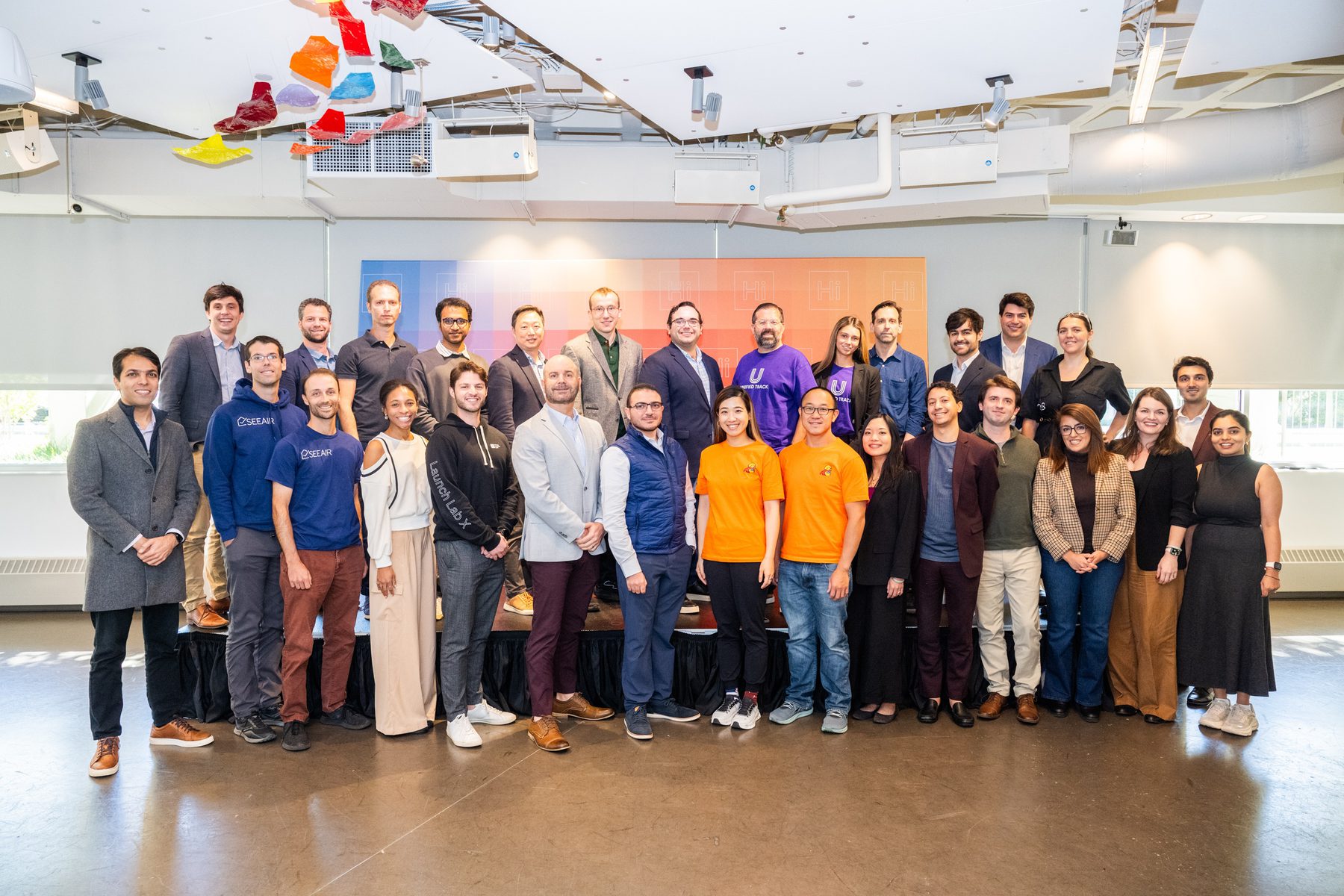
Fast forward to 2025, having a strong product foundation and customer traction, Hanna was looking for accelerators to help Mona scale with intention. When he learned more about Launch Lab X, the Harvard Innovation Labs accelerator for startups founded by Harvard alumni, he immediately applied. “I thought it would be the type of environment I'd like to be a part of as we try to dream big about what Mona could be,” he shared.
Three months in the LLX program, Hanna said “it’s helped a lot. The community is great, and it’s pushed us a lot in terms of how we’re thinking about using AI responsibly to automate processes while still having a human-first approach.”
Learning from experience
In reflecting on Mona's rapid growth, Hanna shared two lessons he learned from founding DreamxAmerica that have carried over to his current venture.
- Truly understand your customers. “With storytelling, the idea of becoming really close to the subject is analogous to a startup where you’re working with customers. It’s the idea of deeply understanding the stories of the people you’re serving, where their passions come from, and how their life stories intertwine with what they're doing today.” When you truly understand “people’s ambitions, goals, and passions,” you’re able to better serve them.
- Running a mission-driven venture is a balancing act. “You have your primary goal, which is making an impact. In the DreamxAmerica case, [that was] telling a story that was authentic and reflective of the dignity of the entrepreneurs. In Mona's case, it’s creating economic mobility for small businesses. Then you also need it to be sustainable. For Mona, finding the right lending and community partners, and offering a premium subscription, has been our team’s approach.”
As Mona enters its next phase of rapid growth, Hanna is focused on scaling its technology and reach without losing the individual, human support that keeps the company close to the small businesses it serves. He evaluates every decision through an “impact-first” lens — measured by whether it tangibly improves outcomes for small business owners. Ultimately, Mona aims to accelerate financial inclusion for every small business — so more entrepreneurs can access the resources they need to grow, hire, and thrive.